Frequently Asked Questions (FAQs)
The Rocky Intertidal
What is the rocky intertidal?
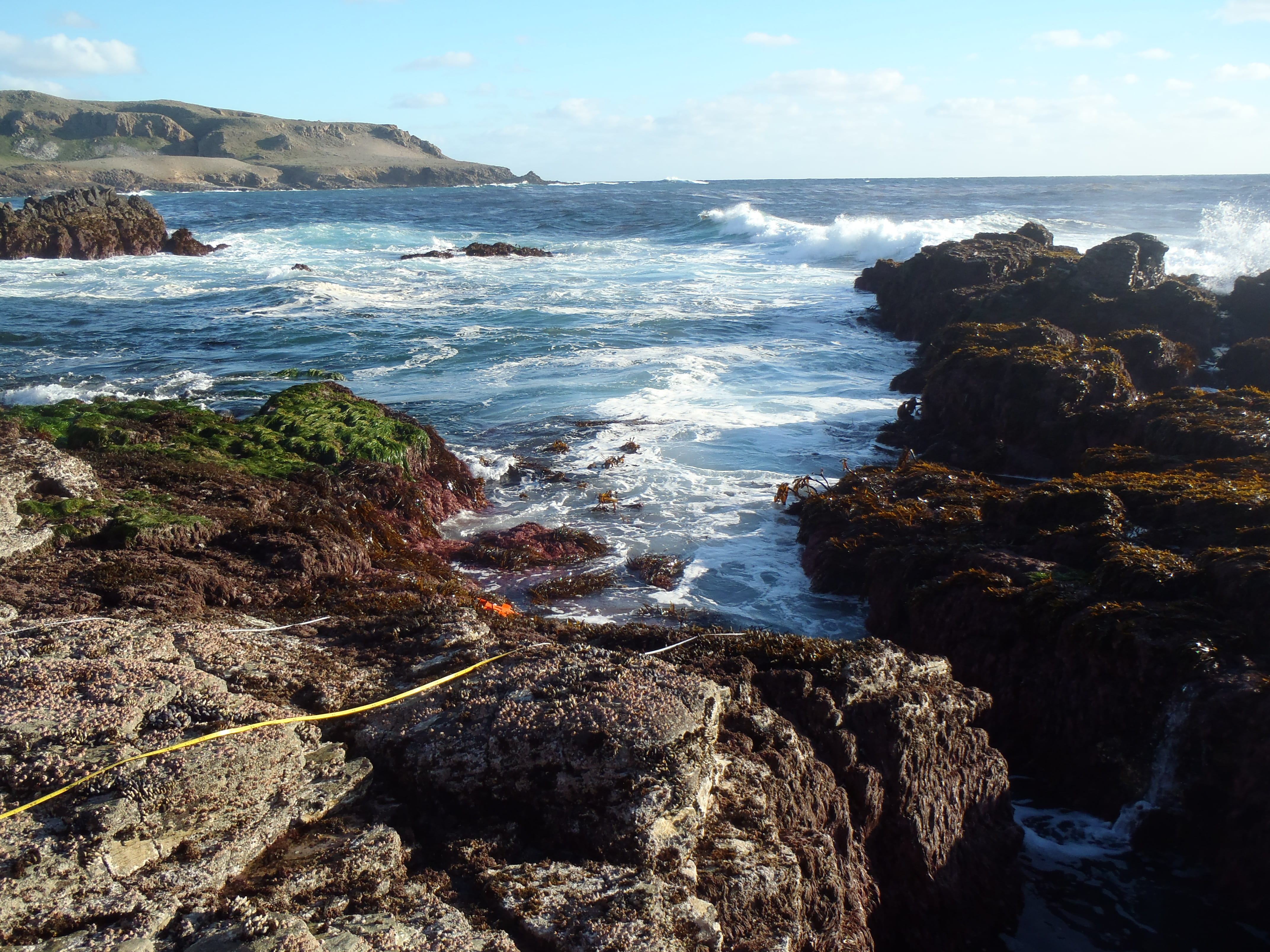
Intertidal regions are, as the name suggests, regions that exist between the lowest low tide and highest high tide along our coastline. Intertidal regions encompass a wide variety of ecosystems, including sandy beaches, estuaries, mangrove forests, and rocky intertidal habitats. The rocky intertidal is specifically any intertidal region that is primarily composed of hard, rocky surfaces, often along jagged coastal cliffs that are routinely splashed by strong waves. All intertidal environments are biologically distinct from one another, with the rocky intertidal primarily containing “tide pool” organisms such as sea stars, sea urchins, limpets, whelks, abalone, kelp, barnacles, mussels, turfy algae, and chitons.
Why is the rocky intertidal important?
The rocky intertidal is a highly dynamic and stressful environment, where organisms are exposed to both marine and terrestrial stress depending on whether the tide is rising or receding. This ecosystem has been the subject of ecological research for decades, as it functions as a barometer to determine how other, less stressful environments may respond to stress in the future [1]. The organisms that reside in and interact with the rocky intertidal include many economically and culturally important species, which is why rocky intertidal and subtidal ecosystems have been deemed critically important habitat by the Pacific Fishery Management Council. These species not only include iconic tide pool organisms such as sea stars and sea urchins, but also juvenile groundfish species and economically important species of algae such as the sea palm (Postelsia palmaeformis), bull kelp (Nereocystis luetkeana), nori (Pyropia spp.), and wakame (Alaria marginata). Beyond the organisms in the rocky intertidal itself, species across the Pacific are affected by the health of the rocky intertidal, including migratory seabirds that feed on intertidal shellfish, baleen whales that feed on plankton partially composed of the larvae of intertidal organisms, and subtidal kelp forests that are ecologically tied to the intertidal through shared species and nutrient cycling.
[1]Paine, R.T. 1977. Controlled manipulations in the marine intertidal zone, and their contributions to ecological theory. Academy of Natural Sciences 12:245-270.
What makes the rocky intertidal along the West Coast unique?
The US West Coast has many shared species across the region, and while physical conditions and species do change from north to south, the general makeup of the rocky intertidal is fairly uniform across the region. In fact, the entire region is considered one large contiguous bioregion, referred to as the California Current Large Marine Ecosystem (CCLME), which stretches from Northern Washington to Baja California. This uniformity is due to strong oceanographic patterns along the coastline that also cause regular upwelling to occur, making the region highly productive and biodiverse compared to many other rocky intertidal regions in the world. This productivity is what has allowed Washington, Oregon, and California to develop robust ocean-related industries (fisheries, aquaculture, tourism, etc.) and has also attracted hundreds of researchers from around the globe to study the CCLME for decades, particularly in the rocky intertidal.
What changes has the West Coast’s rocky intertidal experienced in the past?
For decades, human activities have caused large scale changes in the rocky intertidal zone along the West Coast. Even prior to the 21st century, thousands of years of indigenous stewardship and conservation have heavily impacted the rocky intertidal. In the last 15 years, the West Coast has experienced multiple stress events that have left the future of the ecosystem relatively uncertain. In 2013, sea star wasting disease (SSWD) began affecting sea star populations along the West Coast, causing massive declines in sea star populations that some species have still not yet recovered from [1]. Concurrently, a marine heat wave known as “the Blob” was detected off the US West Coast, which not only heavily affected rocky intertidal communities directly, but also may have increased the spread and severity of SSWD [2]. Beyond these major events, the past 15 years have also seen an increase in the frequency and intensity of other nearshore stressors such as hypoxia [3] (low oxygen), ocean acidification [4], and harmful algal blooms [5] (HABs; see our report on West Coast HABs).
[1] Gravem, S.A., et al. 2021. Pycnopodia helianthoides. The IUCN Red List of Threatened Species 2021: e.T178290276A197818455.
[2] Bates, A.E., et al. 2009. Effects of temperature, season and locality on wasting disease in the keystone predatory sea star Pisaster ochraceus. Diseases of Aquatic Organisms 86(3):245-251.
[3] Barth J.A., et al. 2024. Widespread and increasing near-bottom hypoxia in the coastal ocean off the United States Pacific Northwest. Scientific Reports14(1):3798.
[4] Gruber, N. et al. 2012. Rapid Progression of Ocean Acidification in the California Current System. Science 337:220-223.
[5] Lewitus, A.J., et al. 2012. Harmful algal blooms along the North American west coast region: History, trends, causes, and impacts. Harmful Algae 19: 133-159.
What changes might the West Coast’s rocky intertidal experience in the future?
The stress events that have characterized the West Coast rocky intertidal in the past 15 years are not occurring by coincidence. All of these events have links to increasing thermal stress and/or increased atmospheric CO2, both of which are increasing rapidly due to human activities. There is even evidence that human activity may alter upwelling dynamics along our coastline [1], which, in their current state, are what makes the US West Coast such a biodiverse and productive region.
While human activity has likely compounded the stress that rocky intertidal ecosystems are experiencing, there is also the potential for human activity to protect these ecosystems. Conservation efforts such as marine protected areas have already been shown to improve the resilience of nearshore ecosystems to the effects of climate change [2]. Other, more direct interventions are also possible, such as the coast-wide captive breeding and recovery effort that is currently underway for sea stars most affected by sea star wasting disease (SSWD).
[1] Bakun, A. 1990. Global Climate Change and Intensification of Coastal Ocean Upwelling. Science 247(4939):198-201.
[2] White, J.W., et al. 2025. Measurements, mechanisms, and management recommendations for how marine protected areas can provide climate resilience. Marine Policy 171:106419.
.
.
Why choose four different focal groups?
While the rocky intertidal is considered one contiguous ecosystem, it is also characterized by distinct zones of organisms that occupy different vertical areas of the rocks depending on how often that section of shoreline is immersed in water throughout the day. The high zone of the rocky intertidal is underwater for the least amount of time, and is home to small, turfy algae such as rockweeds, as well as smaller invertebrates such as barnacles and limpet snails. The mid zone of the rocky intertidal almost entirely covered in dense mussel beds and also includes algae like the sea palm and other invertebrates like gooseneck barnacles, small sea stars, and predatory whelks. The low zone of the rocky intertidal is immersed in water for most of the day and is mostly composed of large kelps and seagrasses. This abundance of algae and seagrasses is thanks to the large ochre sea stars in the region, who aggressively feed on mussels trying to encroach into the low zone from the mid zone.
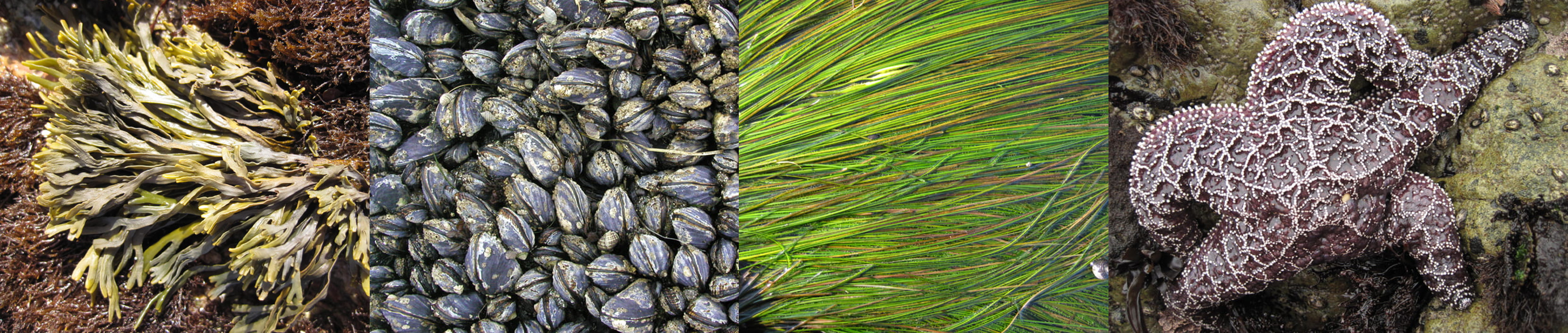
Because of these distinct zones with different ecological dynamics, the rocky intertidal cannot be studied effectively without considering multiple species and their dynamics within their environment. Due to limitations in the existing monitoring data along the West Coast, a full community-level assessment of the rocky intertidal that factored in all possible species was determined to be unrealistic to produce at this time. Instead, our expert working group chose to assess key focal groups within the rocky intertidal whose trends and status could be combined to paint a relatively comprehensive picture of how the rocky intertidal is doing at a community level. The four focal groups of rockweeds, mussels, seagrasses, and ochre sea stars were chosen because each are key players in their zone of the intertidal that may have been affected by the recent stress events of sea star wasting disease and/or the “Blob” marine heat wave.
What are rockweeds?
Rockweeds are an order of brown algae that primarily include smaller, turfy species living in the high zone of the rocky intertidal. Rockweed species in the West Coast rocky intertidal generally belong to the Fucus, Pelvetiopsis, or Silvetia genera.
Rockweeds are a key source of food and habitat for organisms in the high zone, including coastal insects, crabs, limpets, and other marine snails.
Beyond their ecological role, rockweeds have been used by humans for a variety of applications. Recently, rockweeds have been used in pharmaceutical research to improve drug delivery systems, assist in tissue engineering, and more [1].
[1] Abbas, M.F., et al. 2025. Fucoidan and its derivatives: From extraction to cutting-edge biomedical applications. Carbohydrate Polymers 357:123468.
What are mussels?
Mussels are large bivalve mollusks that live their entire adult lives anchored to the rocky intertidal shore. Along the US West Coast, most large mussel beds are composed of the California mussel (Mytilus californianus), with the smaller blue mussel (Mytilus trossulus) also present at some locations. In southern California, the invasive Mediterranean mussel (Mytilus galloprovincialis) has been present for decades, where it thrives in warmer waters similar to its native habitat.
Mussels are considered a foundation species in the mid intertidal zone, meaning that they occupy a large amount of space in the ecosystem and are an abundant source of food and habitat for other organisms. The habitat they create tends to be much cooler than the surrounding rock, meaning that they can help shield other organisms from intense heat events, particularly when they are exposed to air during low tide [1]. Animals such as whelks, seabirds, sea stars, and sea otters regularly feed on mussels.
Mussels are also a historic and modern food source for humans. In 2023, United States mussel aquaculture produced $22.5 million in sales. Outside of their direct role as a food source, mussels also provide ecosystem services to coastal human populations, most notably through their filtering of toxins from nearshore waters.
[1] Jurgens, L.J. and B. Gaylord. 2017. Physical effects of habitat-forming species override latitudinal trends in temperature. Ecology Letters 21(2):190-196.
What are seagrasses?
Seagrasses are the only flowering plants that grow in ocean waters and are primarily found in the low zone of the intertidal. On the West Coast, intertidal seagrasses include surfgrasses in the genus Phyllospadix and eelgrasses in the genus Zostera.
Seagrasses occupy a large amount of rock space in the low intertidal, where they provide key habitat for smaller organisms, particularly juvenile forms of organisms such as mussels, sea stars, and fish.
What are ochre sea stars?
Sea stars are a group of slow-moving invertebrates that can be found throughout the low and mid zones of the rocky intertidal. The most common and recognizable of these species is the ochre sea star (Pisaster ochraceus).
Sea stars in the intertidal are typically predators, eating other, smaller invertebrates such as mussels, whelks, and other sea stars. The ochre sea star is famous for its role in the rocky intertidal as a keystone predator, meaning that it is so impactful as a predator that it fundamentally changes the structure of the community when it is present. The ochre sea star achieves this by eating enough mussels to allow other competing species such as kelp and barnacles to regularly occupy rock space in the low zone [1]. West Coast sea star populations have been heavily impacted by sea star wasting disease, a Vibrio bacterial infection that destroys tissue and is almost always fatal without human intervention. While some species of sea stars (such as the ochre sea star) are recovering, others (such as the sunflower sea star) are still heavily impacted and are completely absent from large regions of the coast that they used to inhabit.
Beyond their large ecological role in the rocky intertidal, ochre sea stars are iconic to the West Coast and are a common tide pool attraction for coastal visitors. They have also been a focal point of scientific research along the West Coast for decades, especially in the field of marine ecology.
[1] Paine, R.T. 1966. Food Web Complexity and Species Diversity. The American Naturalist 100(910):65-75.
Focal Groups
.
.
Research and Monitoring
How is the rocky intertidal being studied and managed?
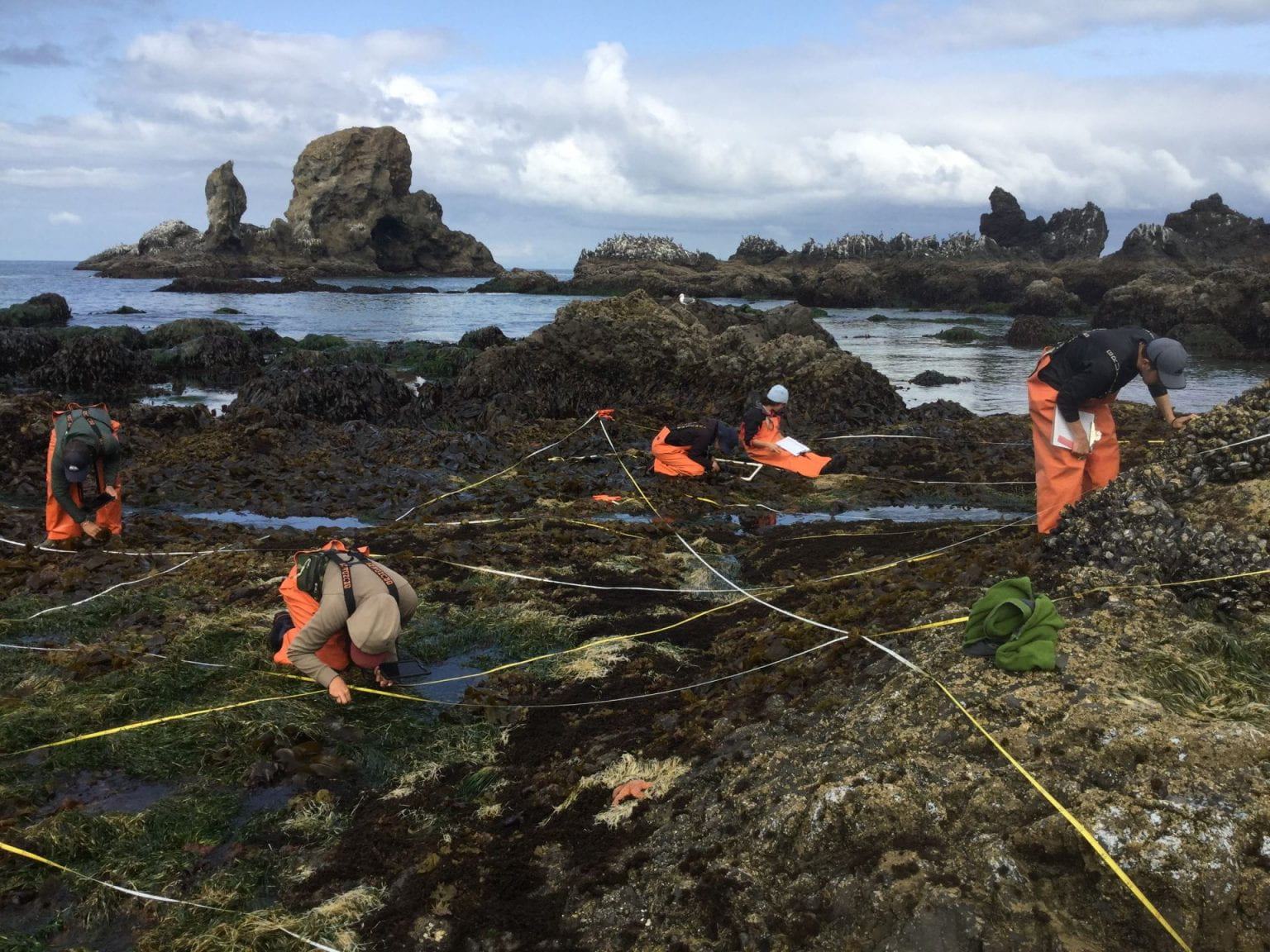
The rocky intertidal of the West Coast has been monitored by multiple research groups for decades. Since 1997, the Multi-Agency Rocky Intertidal Network (MARINe) has been monitoring sites from Baja California to Alaska, with their most regular monitoring occurring across the California Coast. The Partnership for Interdisciplinary Studies of Coastal Oceans (PISCO) has been monitoring sites in Oregon and Northern California since 1999, with their most regular monitoring across the Oregon Coast. Washington rocky intertidal monitoring is a coordinated effort between MARINe, Olympic National Park, the Makah Tribe, and the Quinault Indian Nation. These long-term monitoring efforts employ similar methods, with research teams determining the abundance of organisms through transect and quadrat measurements in the field. The development of the Ocean Health Dashboard indicator for the rocky intertidal has provided a novel space for these monitoring teams to come together as subject matter experts to compare trends and datasets for the rocky intertidal along the West Coast.
Outside of the indicator expert working group, researchers along the coast are pioneering new methods of monitoring and understanding rocky intertidal ecosystems. For example, at the University of Washington, the Marine Landscape Ecology Lab is using drone imagery to understand trends in rocky intertidal communities. Additionally, the Tribal Marine Stewards Network’s Tribal Intertidal Digital Ecological Surveys (TIDES) project in California is using advanced photography to create 3D habitat models of rocky intertidal communities over time.
In Washington, Oregon, and California, marine reserves and other marine protected areas (MPAs) have been established to protect key nearshore habitat, including rocky intertidal ecosystems. The protections within these managed areas vary depending on their designation and the management agencies in charge of administering them, but many involve at least some restrictions on the harvest of organisms and other commercial or recreational activities. These restrictions help intertidal populations maintain higher numbers and keep them from being exposed to the additional stress that higher human activity in the area may bring (trampling, litter/pollution, improper handling of organisms, etc.).
In certain cases, statewide or coastwide closures of fisheries are necessary to prevent the complete extinction of a given species. The most notable case of this in the rocky intertidal along the West Coast is the continuing harvest ban on multiple abalone species in Washington, Oregon, and California.
For cases where declined species are not recovering even after protections such as MPAs or harvest bans are put in place, West Coast state governments and research groups are coordinating reintroduction and captive breeding programs to bolster wild populations. These efforts are occurring for sea stars after their steep decline as a result of sea star wasting disease (SSWD).
Where can I learn more?
A summary of the rocky intertidal indicator can be found on the landing page. To learn more about how the indicator was developed, explore the Methods page. To see a more detailed explanation of the current status and historic trends of the rocky intertidal, view the Explore the Indicator page. To learn about the research groups and assessments studying the West Coast rocky intertidal, read the Programs and Assessments page.